致未來世代的美術史—臺灣美術以人為本的共融之路
〈自畫像〉畫作資訊與口述影像
〈自畫像〉
席德進
1963
油彩、棉布
90*64.5公分
畫作口述影像
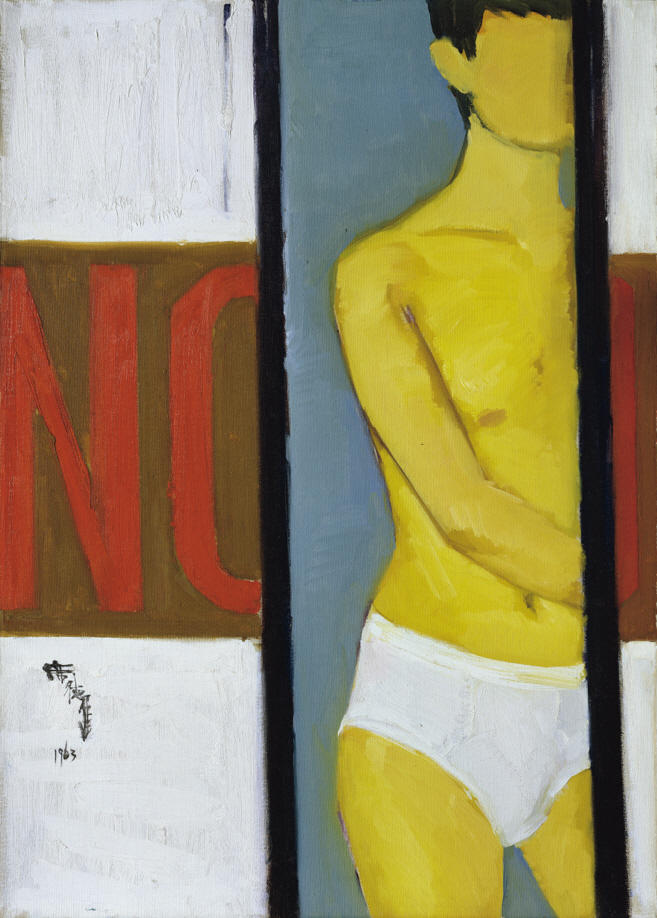
自畫像反映畫家對自我的觀看和檢視。席德進這幅〈自畫像〉是1963年創作的油畫。長90公分,寬64.5公分。
畫面右邊有一個像是穿衣鏡的長方形,裡面呈現一個男子從前額到大腿的局部身形。男子有黑髮和黃皮膚,偏瘦的身軀只穿了一件白色的三角褲;臉上沒有五官。鏡子兩邊平塗著白色的油彩,像是牆壁。一道寬幅的咖啡色橫線貫穿牆面中央,上面寫著表示拒絕、反對的NO兩個紅色的英文大寫字母。左下角有席德進的簽名。
前一段描述裡的白色牆面、寬幅的咖啡色橫線和像是穿衣鏡的長方形等等大面積的色塊,都用沒有明暗光影的方式塗滿,是融入了當時西方現代藝術不強調立體空間感的特徵。空間感不足,不容易分辨前後,所以,也有人看這幅畫時,會把白牆看成是一道寫著NO兩字的拉門,席德進正拉開這道象徵拒絶的門。
這幅自畫像不是一般人物畫形體完整、衣著反映形象或描繪表情神韻的寫實作法。而是著重在畫家想要傳達的意念。席德進曾在雜誌介紹西方當代藝術時表示,紐約滿大街都是NO的招牌,NO宣示了你的態度和拒絕,也同時表明你的YES:你知道你要的是什麼。
觀眾們覺得,席德進想藉由這幅畫表達什麼呢?
Audio Description
Self-portraits reflect an artist's introspective view and observation of themself. The artwork here is titled Self-portrait. It is an oil painting created in 1963 by SHIY De-jinn. The painting is 90 centimeters tall and 64.5 centimeters wide.
On the right side of the painting, there's a rectangular shape resembling a full-length mirror. The mirror reflects a partial view of a man, specifically from his forehead to his thighs. The man in the mirror has black hair and yellow skin. He is slim and wearing only a pair of white briefs. There are no facial features drawn on his face. Areas on the left and right sides of the mirror are painted with white oil paint, which appears to be a wall. A broad, brown strip stretching horizontally across the middle of the wall, with two large, red uppercase English letters: "NO" written in this brown strip. In the bottom left corner is a signature by the artist, SHIY De-jinn.
The large color blocks mentioned before – the white wall, brown strip, and rectangular shape that appears to be a full-length mirror – are painted full, without any distinction of light or shadow. The de-emphasis of three dimensionality is characteristic of modern Western art at the time. The lack of spatial depth, therefore, makes it difficult to distinguish between the foreground and background, leading some to interpret the white wall as a sliding door with the word "NO" written on it, and imagine that SHIY De-jinn is opening this door of rejection.
This self-portrait is not a typical portrait with realistic depictions of a full body, clothing that reflects personality, or expressions and emotions. Instead, it focuses on the ideas that the artist wants to convey. In a magazine article introducing Western contemporary art, SHIY De-jinn mentioned that "NO" signs are everywhere in New York. “NO" is a declaration of your stance and rejection, but also your “YES” – you know what you want.
What do you think SHIY De-jinn is trying to express with this painting?